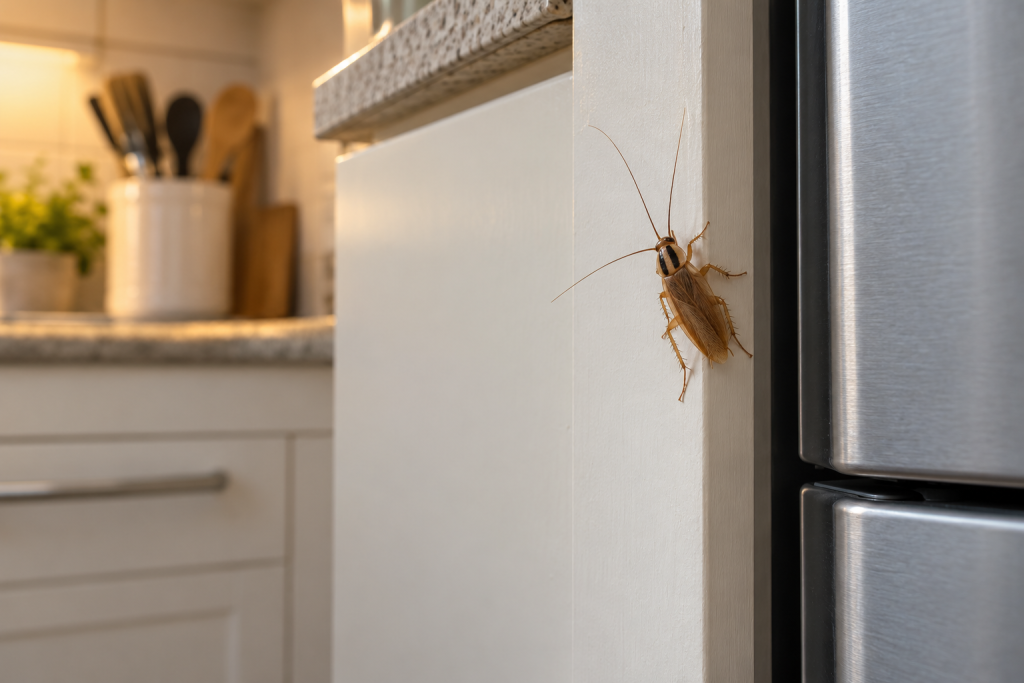
A quick movement behind a fridge is easy to dismiss when you are busy cooking. It is also easy to mistake a small dark insect for a cockroach when the light is poor. The useful next step is to record what you saw and look for a pattern around the appliance, without pulling heavy equipment into the room or spraying an unidentified insect. German cockroaches favour warm, sheltered places close to food and moisture, so kitchens offer several potential harbourages. A single sighting deserves attention; it does not, by itself, establish the size or source of a problem.
What a German cockroach looks like
An adult German cockroach is relatively small, light brown to tan, with a flattened oval body, long antennae and two darker parallel markings behind the head. It moves quickly and may disappear into a narrow gap when disturbed. Younger stages, called nymphs, are smaller and darker. Their size can make them look unlike the adult at first glance. A photograph from a safe distance, ideally with a familiar object for scale, can be more useful than a description from memory.
Identification matters because different insects turn up in kitchens. A beetle, an outdoor insect drawn indoors or an Oriental cockroach calls for a different interpretation of where to inspect. Avoid declaring a species from a blurred picture or from the fact that the insect appeared near an appliance. If you can safely collect a specimen in a sealed container, keep it for identification. Never put a hand behind an energised appliance or into a service void to catch one.
Why appliances are worth checking
A fridge, freezer, dishwasher or cooker can create a combination of warmth, darkness and limited disturbance. Crumbs and spills may collect beside or beneath it. Pipework can bring moisture, and a cable or service opening can connect the kitchen to a concealed route. These are inspection leads, not proof that the appliance itself is infested. A professional assessment considers adjoining cabinets, skirting gaps and plumbing rather than treating one visible spot as the whole problem.
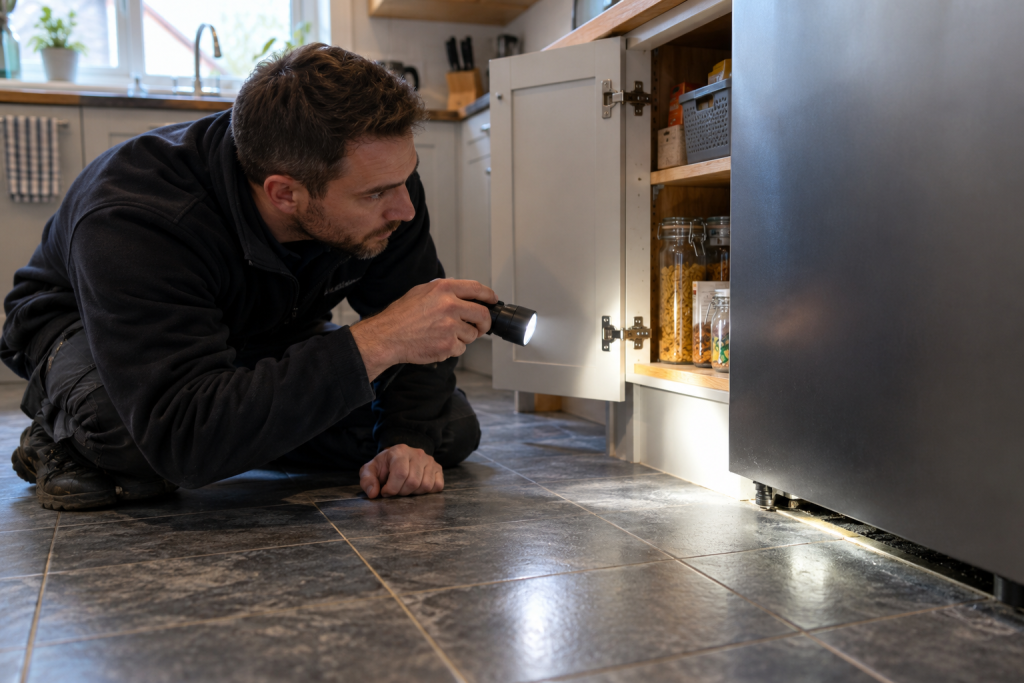
Look first where access is ordinary and safe: the floor edge beside the appliance, the outside of nearby cupboard hinges, accessible kickboards and visible pipe entries. Use a torch from an open position. Do not remove electrical panels, disconnect a gas appliance or shift a heavy unit without suitable help. If there are children or pets, keep them away from any area you have opened for inspection.
Five forms of evidence to record
Live insects
Note the time, exact location and direction of travel. Cockroaches are generally more active when the kitchen is quiet, so a sighting after dark can be informative. A daytime sighting is still worth recording, but it does not automatically prove a severe infestation. Sudden disturbance, cleaning or movement of equipment can bring a hidden insect into view. If several sizes are seen in the same area, mention that; the observation may help a specialist decide where to inspect next.
Small dark specks
Cockroach droppings can appear as dark flecks or smears near harbourages. They are easily confused with cooking residue, dust and other debris. Photograph the marks before wiping them away, including a wider view that shows where they sit. Repeated marks at a cabinet joint or behind an accessible kickboard matter more than an isolated fleck on a worktop. Do not handle suspect material with bare hands or brush it into the air.
Cast skins
Cockroaches shed their outer covering as they grow. A light, insect-shaped cast skin found in a sheltered kitchen gap can support an identification when it matches other evidence. It is not enough to rely on a cast skin alone; other household insects moult too. Photograph both sides if possible and leave the surrounding area undisturbed until it can be examined.
Egg cases
A German cockroach female carries an egg case for much of its development. An empty or discarded case may be found near shelter, but a small brown object in a cupboard is not automatically a cockroach egg case. Keep a specimen if you can do so safely. The object, its location and any live insects together are more useful than one photograph taken in isolation.
Monitor catches
A properly placed crawling-insect monitor can help establish which areas are active and whether activity changes over time. It does not measure the total population in a property. A monitor near a fridge may catch insects moving along that route while missing another harbourage altogether. Record the date it was set and check it without touching the adhesive surface. If a professional has placed monitors, leave them where agreed and report the catches.
What to do before an inspection
Keep food in closed containers and clear exposed crumbs and spills using your normal food-safe cleaning routine. This protects food and makes later evidence easier to interpret. Empty a nearby cupboard only if you can do so without transferring insects or suspect packaging to another room. Keep any photographs, specimens and a brief timeline of sightings. Tell the pest controller if you have already used a spray, bait or other product, including where and when it was applied.
Avoid putting aerosol insecticide into appliance vents, sockets or electrical housings. Do not combine several products in the hope that one will work. Product labels and professional directions exist for safety as well as effectiveness. The Health and Safety Executive advises householders to consider whether a biocide is needed, to use a product suitable for the intended purpose and to follow its label; professional-use products should not be used by the public. In a food preparation space, misplaced chemicals can add a problem while obscuring the evidence needed for targeted treatment.
Shared kitchens and blocks of flats
In a flat, a sighting near plumbing may raise a question about shared service routes. It does not establish that an adjoining household is the source. Keep the report factual: the room, appliance, dates, photographs and any monitor results. A landlord, managing agent or building manager may need to arrange access to common areas or other affected units. Coordinated inspection can be more useful than repeated treatment of one kitchen when activity is moving through shared spaces.
If the kitchen serves a business, protect food, utensils and stock and follow the site’s reporting procedure. Record sightings and actions so that a pest controller can review trends and provide a clear service record. The Food Standards Agency’s food-business guidance calls for regular checks for signs of pests and attention to deliveries, bins and premises hygiene. That routine is useful background; it does not replace species identification and a treatment plan where cockroaches are established.
When to seek professional help
Repeated sightings, nymphs of different sizes, fresh marks around multiple appliances or catches in more than one location all justify a prompt inspection. Seek help sooner if insects are seen around food preparation, if the affected area is shared or if the evidence is spreading beyond the kitchen. A specialist can identify the insect, inspect accessible harbourages and discuss monitoring and suitable treatment. Their findings should explain what has been checked, what remains inaccessible and what follow-up is needed.
Read the site’s cockroach treatment service for the inspection-led approach. The wider insect control overview explains why identification guides the method. If you are ready to arrange an assessment, contact Local Pest Controllers Harrow with your postcode and a short account of the signs. You can also review how the business approaches inspections before booking.
A useful report is specific
“Something ran behind the fridge” is a starting point. Add the colour and approximate size, when it happened, whether you saw similar insects again and where any marks or cast skins were found. Keep the photographs unedited and note if an appliance or cupboard was moved before the sighting. Those details help separate a one-off observation from a persistent route and make the first inspection more focused. Until the insect is identified, protect food, maintain ordinary cleaning and avoid unsafe attempts to reach concealed spaces.